A possible fall.
An alert so your staff can check on them, even if they couldn’t call for help.
GALARYA CARE · FACILITIES
Fall detection, out-of-bed alerts, and heart and breathing rate alerts for senior living communities, nursing homes, clinics, and hospitals. Your team reviews each alert, checks on the resident, and follows your facility’s own protocol.
Galarya Care installs the sensors, trains your team, and stays on for support.
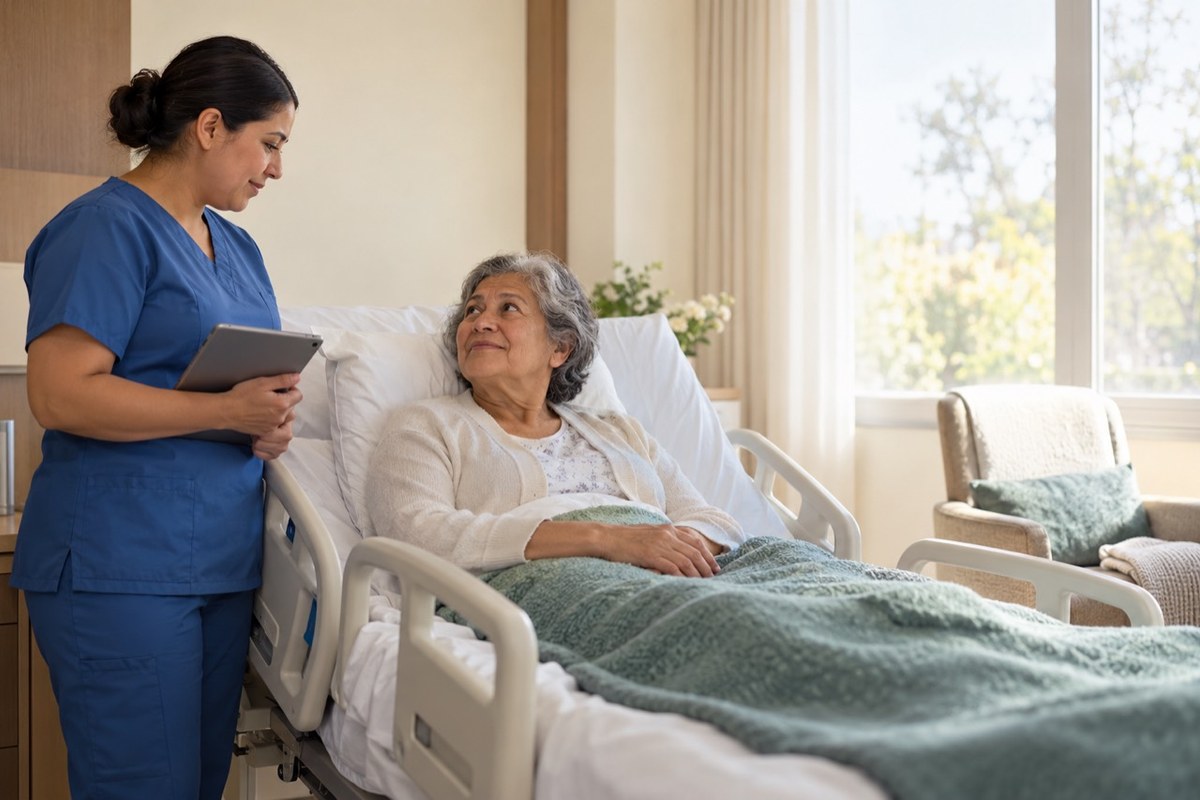
Illustrative image.
BETWEEN ROUNDS AND SHIFT CHANGES
An extra layer of awareness, so attention goes where it’s needed.
No one can watch every room at once. If someone falls and can't get up, the alert reaches the nursing station as soon as the sensors detect it, even between rounds. Especially on short-staffed shifts, alerts tell your team where to look first. They don't replace nurses, caregivers, security, or rounds.
SITUATIONS YOUR TEAM KNOWS
Information your team can act on, using its own judgment.
An alert so your staff can check on them, even if they couldn’t call for help.
A reading above or below the range set for them triggers an alert.
While they rest, a breathing rate outside the set range triggers an alert.
If they get up and don’t return within the expected time, your team gets an alert.
Either one alerts your team.
Heart rate, breathing rate, and time limits are set with your team at installation and can be adjusted later.
Examples depend on equipment, coverage, and configuration. Not every event can be detected. Some devices use radar; others combine radar with thermal imaging.
It’s not a diagnostic tool and doesn’t replace clinical judgment.
HOW IT’S SET UP
Every room is set up for its own layout. This is a typical setup: two sensors in the bedroom and one in the bathroom.

Radar. Out of bed and not back, time in bed, and, depending on the device, heart and breathing rate during rest.
Radar. Fall detection, presence, and no movement.
Radar. Fall detection and extended stays.
Coverage zones overlap. Actual coverage for each room is verified at installation.
For illustration only. No video cameras. Radar and thermal imaging don’t produce a recognizable image of the person.
LIVE VIEW FROM THE NURSING STATION
On radar-equipped beds, your staff sees heart rate, respiratory rate, whether the person is in bed, and their activity, live and contactless, right from the console. It's the same console where possible-fall, bed-exit and help-button alerts arrive, with their response log.
Contactless supplementary readings; not a medical monitor and not a substitute for clinical assessment. Available with compatible devices.
RESPONSE WITH FOLLOW-UP
Your facility sets the protocol. Galarya Care sets it up with you in the console.
The alert appears on the console at your nursing station, with the room, alert type, and time. In rooms with a thermal imaging device, it also includes a thermal snapshot from that moment, so staff can check before they get there.
Your staff goes to the room and checks.
They follow your facility’s protocol: provide care on site, notify the doctor, or call the family or emergency services.
They log what they did, and when, in the console.
The case is closed and available for management and audits, and can be shared with families if your facility chooses to.
Galarya Care does not carry out the response: your facility’s staff provides care and keeps the records, as set out in your service agreement.
FOR YOUR FACILITY
See what happened on each shift: the alerts, who handled them, what was done, and when. A record management and auditors can review, and that families can see if you choose. Galarya Care provides the platform, the sensors, installation, training, and support.
Alerts show where attention may be needed, especially at night and between rounds. Your staff decides how to respond, following your facility’s protocols.
You don't need to cover the whole facility on day one. Start with the residents who need it most: previous falls, nighttime confusion, or limited mobility. Then add beds at your own pace.
TECHNOLOGY FOR YOUR SPACE
Alongside radar sensors, Galarya Care integrates devices that combine radar and thermal imaging, and help buttons. The same sensors alert your team if a resident leaves their room and doesn’t return within the set time. We work with you on coverage and setup, and explain what information each device collects.
Galarya Care isn’t tied to one brand. Our platform brings alerts from compatible devices into one place. New devices are added once we’ve tested and integrated them.
CONTACT US ABOUT YOUR FACILITY
Share how your facility operates and we’ll talk through what would help.
U.S. +1 619 601 5147Mexico +52 664 188 8071contacto@galarya.mxTijuana, Baja California